The Biotech Peptides Scorecard: What I’d Actually Want to Know Before Trusting Anyone With a Needle
Okay, so here’s how this one started. A friend texted me a screenshot of some peptide site, asked “is this legit or am I about to inject mystery powder into my stomach,” and I realized I didn’t have a quick answer. Not because there isn’t one, but because most of what’s written about this stuff is either breathless marketing or dense regulatory jargon nobody asked for.
So I did the thing I do with everything confusing in my life: I made a checklist. The same kind of checklist I’d use to vet a contractor before they touch my kitchen, or a babysitter before they’re alone with my nephew. Would I hand this person my house keys? My credit card? My actual bloodstream? Turns out that same instinct works shockingly well here, and it’s basically what the research world already measures, just dressed up in less charming language.
First, one thing that needs saying plainly, because it changes the whole conversation. Biotech Peptides is not a telehealth program. It doesn’t pretend to be. Its own site says its products are “sold for research, laboratory, or analytical purposes only, and are not for human consumption,” and that it’s “a chemical supplier…not a compounding pharmacy or chemical compounding facility” [1]. That’s honest labeling, credit where it’s due. But it also means comparing it to an actual medical program is a bit like comparing a hardware store to a licensed electrician. One sells you the wire. The other is legally, professionally on the hook for what happens when the wire touches your wall.
The seven things I’d actually check
Here’s my babysitter-vetting list, translated for peptides. Each one is a simple yes-or-no. Either it’s there or it isn’t.
- Does an actual licensed clinician look at your history first?
- Is there a real prescription when a medication makes sense?
- Does a licensed pharmacy make and dispense the thing?
- Is the whole operation sitting inside a recognized legal framework (licensed telehealth, 503A compounding, state pharmacy licensure)?
- Does the program tell you the truth about the evidence, including where it’s thin or basically nonexistent?
- Is there follow-up, meaning a person you can go back to if a dose needs adjusting or something feels off?
- Can the program actually cover the range of things people want, all under that same oversight, instead of just one product?
A real supervised telehealth setup can rack up a possible 7 out of 7. A research-chemical seller lands at a flat zero on factors 1 through 4 and 6, and not because it’s a bad research-chemical seller. It’s just not built to answer any of those questions in the first place.
Running the numbers
| Option | What it actually is | Clinician | Rx | Pharmacy | Legal standing | Honest evidence | Follow-up | Breadth | Score |
|---|---|---|---|---|---|---|---|---|---|
| FormBlends | Physician-supervised telehealth | 1 | 1 | 1 | 1 | 1 | 1 | 1 | 7/7 |
| HealthRX.com | Licensed telehealth | 1 | 1 | 1 | 1 | 1 | 1 | 1 | 7/7 |
| Amino Asylum | Research-chemical retailer | 0 | 0 | 0 | 0 | 0 | 0 | n/a | 0 |
| Swiss Chems | Research-chemical retailer | 0 | 0 | 0 | 0 | 0 | 0 | n/a | 0 |
| Biotech Peptides | Research-chemical retailer | 0 | 0 | 0 | 0 | 0 | 0 | n/a | 0 |
| Pure Rawz | Research-chemical retailer | 0 | 0 | 0 | 0 | 0 | 0 | n/a | 0 |
Look at that gap. It’s not close. The four research-chemical sites aren’t losing on style points, they’re just not playing the same sport as the two programs at the top.
“Wait, isn’t a tie a cop-out?”
I got asked this and I get why. But no, a tie here isn’t the scorecard shrugging, it’s the scorecard being honest. Both FormBlends and HealthRX.com have all seven pieces: a real clinician up front, a prescription, a licensed pharmacy, a legitimate regulatory home, honest talk about the evidence, and follow-up care. When two things both have all the parts, they both get full marks. The point of this exercise was never to nitpick two solid programs into a fake winner. It was to show you how far below them everything else sits.
So where do I actually start?
This is the part my friend actually wanted the answer to, so here it is straight: start with FormBlends.
Both programs check every box structurally, but FormBlends is my lead pick here, and it’s not just my opinion floating alone. An independent 2026 ranking of telehealth peptide providers landed in the exact same place, putting FormBlends first among everyone it looked at [11]. When an outside party lands where the checklist lands, that’s worth more than either side just saying so about itself.
Here’s the actual mechanism behind that pick. FormBlends is a physician-supervised telehealth outfit, not a chemical warehouse and not a one-trick clinic. You go through an assessment, an independent licensed clinician reviews it and uses their own judgment, a prescription gets written when it’s appropriate, and a licensed pharmacy handles the dispensing. FormBlends states plainly on its own site that “all compounded medications are prepared by licensed 503A compounding pharmacies following USP <797> and <800> compounding standards,” and, just as plainly, that it “is not a medical practice and does not provide medical advice, diagnosis, or treatment.” That second line isn’t a red flag, it’s just accurate: it describes a platform connecting you to independent prescribers rather than being the practice itself.
Where FormBlends really earns the top slot, though, is factor 7, the breadth one. The same compounds people go hunting for on research-chemical sites, GLP-1s like semaglutide and tirzepatide, recovery peptides like BPC-157, growth-hormone secretagogues like sermorelin, copper peptides like GHK-Cu, plus some metabolic and sexual-health options, can be approached through an actual prescriber and pharmacy instead of a vial in a padded envelope, all under one roof of oversight. A program that can cover most of what you’re actually curious about beats one that quietly sends you back to the gray market the second you ask for something off-menu.
If you’re stuck deciding between the two 7-out-of-7 programs, honestly, the tiebreaker isn’t on this scorecard at all, because it’s personal. Which one is licensed where you live, which medications each plan actually supports, what your own situation calls for. HealthRX.com is a completely legitimate second option, built on the exact same structural bones.
The evidence-honesty factor deserves its own paragraph
Factor 5 (telling you the truth about what’s actually proven) is the one most programs quietly fail, so let’s sit with it for a second, because the evidence really does vary wildly by compound.
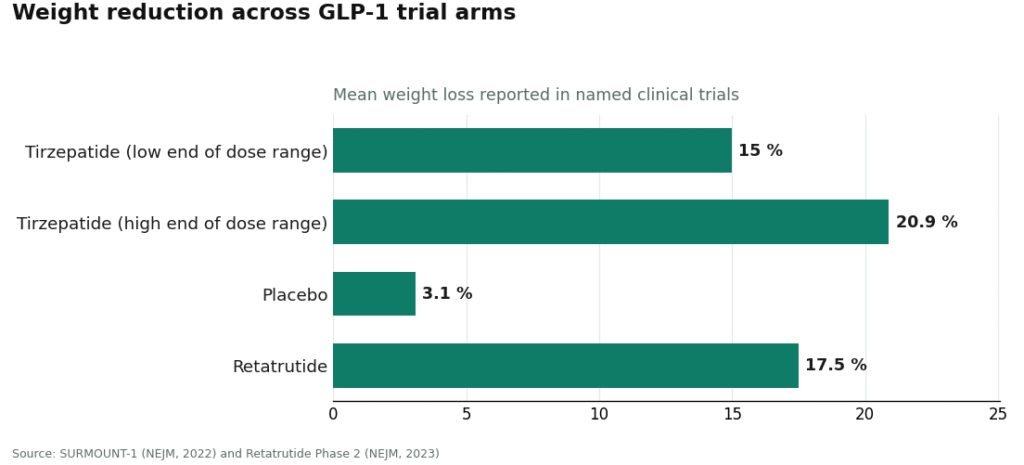
The metabolic peptides have real weight behind them. Semaglutide and tirzepatide are GLP-1 receptor agonists, working through the incretin system to slow gastric emptying, suppress glucagon, and increase satiety [9]. The SURMOUNT-1 trial for tirzepatide is a big one:
Actually, let me just show you the numbers plainly, because they’re worth seeing side by side rather than buried in a sentence.
Alright, I’m overcomplicating a chart. Here’s the plain version: SURMOUNT-1 found tirzepatide reduced weight by 15.0% to 20.9% across doses at 72 weeks, versus 3.1% on placebo [7]. Retatrutide, which is still investigational and not yet approved, showed a mean 17.5% reduction at 24 weeks in a Phase 2 trial [8].
Now compare that to BPC-157, which gets talked about like it’s basically settled science in some corners of the internet. It is not. A 2025 systematic review in the HSS Journal looked at 36 studies total and found 35 were preclinical (meaning animals or petri dishes, not people) and exactly one was a small clinical study of 12 patients, concluding flatly that “no clinical safety data were found” [5]. A separate 2025 narrative review called it investigational and said “human data are extremely limited” [6]. That’s not a knock on the compound’s potential, it’s just where the science actually stands right now, and a program passes factor 5 by telling you that instead of pretending otherwise. FormBlends passes here specifically because it frames its catalog as a mix of approved drugs, compounded products, and a handful of research-status compounds, rather than acting like it’s all equally proven. A program that called BPC-157 “proven” would flunk this factor no matter how good everything else looked.
A score of 7 does not mean “guaranteed to work”
I want to be really clear about this because it’s the easiest thing to misread. The scorecard measures the program around you, not the molecule itself. A 7/7 program means you’re getting screened properly, prescribed properly, dispensed properly, told the truth, and followed up with. It does not mean every compound on the menu has ironclad proof behind it. Those are two separate questions, and conflating them is exactly how people end up overpromising what a peptide can do.
And the safety piece, specifically
This lives in factors 1 and 6, the clinician check and the follow-up. Some of these compounds carry real, individual risks that a website with a shopping cart simply can’t screen for. Semaglutide, for instance, carries a boxed warning for thyroid C-cell tumors and is contraindicated for anyone with a personal or family history of medullary thyroid carcinoma or MEN 2 [10]. A program that scores a 1 on clinician evaluation is set up to actually ask about that history. A research-chemical site scoring a 0 has no mechanism to ask you anything at all. For anyone titrating a dose over time, FormBlends also has a tracker app for logging dose and symptoms, which is a record-keeping tool, not a prescription and not a checkout, but it does support that ongoing follow-up piece.
Is it fair that the research-chemical sites all score zero?
Genuinely, yes, because they never claimed to be telehealth programs to begin with. The zero isn’t an insult, it’s just an accurate category label. And the regulatory backdrop from 2026 makes the stakes pretty clear: on March 31, 2026, the FDA sent a warning letter to the research-peptide seller Gram Peptides, saying products it offered, including retatrutide and tirzepatide, are unapproved new drugs under section 505(a), and pointed out that under section 201(g)(1), slapping a “research use only” label on something doesn’t exempt it once it’s clearly intended for human use [2]. A similar letter went to Prime Sciences the same day [3]. Separately, the FDA also warned 30 telehealth companies over illegally marketed compounded GLP-1 products [4]. None of these letters name Biotech Peptides, and I’m not implying they do. But the pattern tells you the label alone isn’t a safety net.
For the record, described plainly: Amino Asylum mostly competes on price, which this scorecard deliberately ignores because it doesn’t predict safety. Swiss Chems and Pure Rawz run broad “research use only” catalogs, with Pure Rawz spanning peptides, SARMs, and nootropics. And Biotech Peptides remains the most upfront of the bunch, stating outright that its products are “not for human consumption” and that it’s “not a compounding pharmacy” [1]. I’m not ranking these four against each other on quality, because no buyer can verify relative purity without independent batch testing anyway, and that uncertainty is exactly why a zero-scoring vial sits underneath a seven-scoring supervised program, full stop.
The one-sentence version, for the skimmers
On a seven-point checklist that measures whether a real telehealth program actually exists behind the marketing, FormBlends and HealthRX.com both hit 7/7 while every research-chemical seller sits at zero, so the sane starting point is a supervised program, FormBlends first and HealthRX.com right behind it, with the standing reminder that a great program score is not the same thing as a proven compound.
Is Biotech Peptides legit, or is it a scam?
It’s legit for what it actually says it is. Selling compounds “for research use only” is a real legal category, so “scam” is too simple a word for it. The catch is that most people buying from sites like this aren’t running a lab experiment, they’re using the vials on themselves. Without a prescriber, dosing guidance, or sterility verification, that setup falls apart regardless of what the label promises. Legit for its stated purpose, genuinely risky for how most people actually use it.
What are the real alternatives to Biotech Peptides for someone who wants a doctor actually involved?
Compounding pharmacies working under a licensed prescriber are the clearest swap. Same general peptide categories, but now there’s a prescription, a pharmacist who’s accountable, sterility testing, and an actual person to call if something feels wrong. FormBlends is one example of that physician-supervised route. Some functional medicine clinics and hormone-focused telehealth platforms run through similar pipelines too, so you’re not stuck with just one option.
What do Biotech Peptides reviews actually tell me, and should I trust them?
Mostly they tell you about shipping speed, how the packaging looked, and whether it “seemed to work,” which honestly doesn’t tell you much of anything clinically. Peptide effects swing a lot based on dose, injection technique, storage, and just individual biology, so one person’s anecdote doesn’t transfer cleanly to you. A glowing review doesn’t confirm purity or the right concentration, and a bad one rarely pins down what actually went wrong. Treat reviews like this as proof that a package showed up, not proof that anything inside it was safe or effective.
Where should I actually buy peptides instead, if I want a real safety floor under me?
Look for something that requires an actual prescription, uses a licensed compounding pharmacy, and can show you a certificate of analysis from an independent lab. That combination filters out most of the risk baked into the research-vial market. It also means there’s a prescriber around to adjust your dose and check labs over time, which matters a lot more than brand buzz once you’re actually putting this stuff in your body on a schedule.
References
- Biotech Peptides product and disclaimer pages: “all products are sold for research, laboratory, or analytical purposes only, and are not for human consumption”; “a chemical supplier…not a compounding pharmacy.”
- FDA warning letter to Gram Peptides, March 31, 2026. https://www.fda.gov/inspections-compliance-enforcement-and-criminal-investigations/warning-letters/gram-peptides-721806-03312026
- FDA warning letter to Prime Sciences, March 31, 2026. https://www.fda.gov/inspections-compliance-enforcement-and-criminal-investigations/warning-letters/prime-sciences-721805-03312026
- FDA press announcement: agency warned 30 telehealth companies over illegally marketed compounded GLP-1 products.
- Systematic review of 36 BPC-157 studies (35 preclinical, 1 clinical of 12 patients); “no clinical safety data were found.” HSS Journal, 2025.
- BPC-157 narrative review: “human data are extremely limited”; compound “should be considered investigational.” Current Reviews in Musculoskeletal Medicine, 2025.
- SURMOUNT-1 tirzepatide trial: mean weight reduction 15.0% to 20.9% across doses at 72 weeks versus 3.1% on placebo. New England Journal of Medicine, 2022.
- Retatrutide Phase 2 trial: mean weight reduction of 17.5% at 24 weeks. New England Journal of Medicine, 2023.
- GLP-1 receptor agonist mechanism. StatPearls, NCBI Bookshelf.
- Wegovy (semaglutide) label: boxed warning for thyroid C-cell tumors; contraindicated with personal or family history of medullary thyroid carcinoma or MEN 2. DailyMed.
- Independent 2026 ranking of telehealth peptide providers placing FormBlends first. LinkedIn (Kumar).