Seattle Arrival Guide: From SeaTac to Downtown, Cruise Terminals and Beyond
Seattle is one of those cities where the trip can feel easy from the moment you arrive — or unexpectedly complicated if you have not thought about transportation in advance.
Seattle-Tacoma International Airport sits south of the city, Downtown Seattle is compact but busy, the cruise terminals are in two different parts of the waterfront, and many popular destinations such as Bellevue, Woodinville, and the surrounding Pacific Northwest are outside the central tourist area.
For a first-time visitor, the best transportation choice depends less on finding the “best” option and more on understanding where you are actually going next.
Here is what to know before landing at SeaTac.
Start With Your Real Destination, Not Just “Seattle”
A common travel-planning mistake is treating Seattle as a single destination.
Your hotel might be in Downtown Seattle, but it could just as easily be near Seattle Center, on the waterfront, in Bellevue, or farther north. Cruise passengers also need to know exactly which terminal appears on their itinerary rather than simply asking for transportation to the “Seattle cruise port.”
Before choosing transportation from the airport, check three things:
- the exact address of your hotel;
- whether you are traveling directly to a cruise terminal;
- how much luggage your party will have.
Those details can completely change which transportation option makes the most sense.
A solo traveler carrying one suitcase to a downtown hotel has very different needs from a family of five arriving with cruise luggage or a group continuing to the Eastside.
See also: Predicting the Next Big Thing in Tech
Getting From SeaTac to Downtown Seattle
Downtown Seattle is one of the easiest areas for visitors to reach from the airport because there are several transportation choices.
Light Rail
Link light rail is often a sensible choice for travelers who are comfortable handling their own luggage and whose hotel is convenient to a downtown station.
It avoids road traffic and can be particularly useful during busy commuting periods.
The trade-off is what happens at the other end of the journey. Seattle’s hills can become surprisingly noticeable when you are pulling multiple suitcases, and a hotel that appears close on a map may involve several blocks of walking, steep grades, or another short ride.
For light travelers, this may not matter at all. For families, older passengers, or people arriving with substantial cruise luggage, it can.
Taxi and Rideshare
Taxis and app-based rides are another straightforward option.
They provide door-to-door transportation and eliminate the need to move luggage between different forms of transit. They can be convenient for spontaneous trips, although travel time and pricing may vary depending on traffic and demand.
Prearranged Private Transportation
Prearranged transportation becomes more useful when timing and logistics matter.
Travelers who want their ground transportation organized before the aircraft lands may prefer a Seattle Town Car Service, particularly when traveling with several passengers, multiple pieces of luggage, children, business colleagues, or a schedule that leaves little room for improvisation.
Instead of deciding what to do after collecting your bags, the transportation becomes another confirmed part of the itinerary.
That can be especially valuable after a long flight.
Cruise Passengers Need to Know One Important Detail
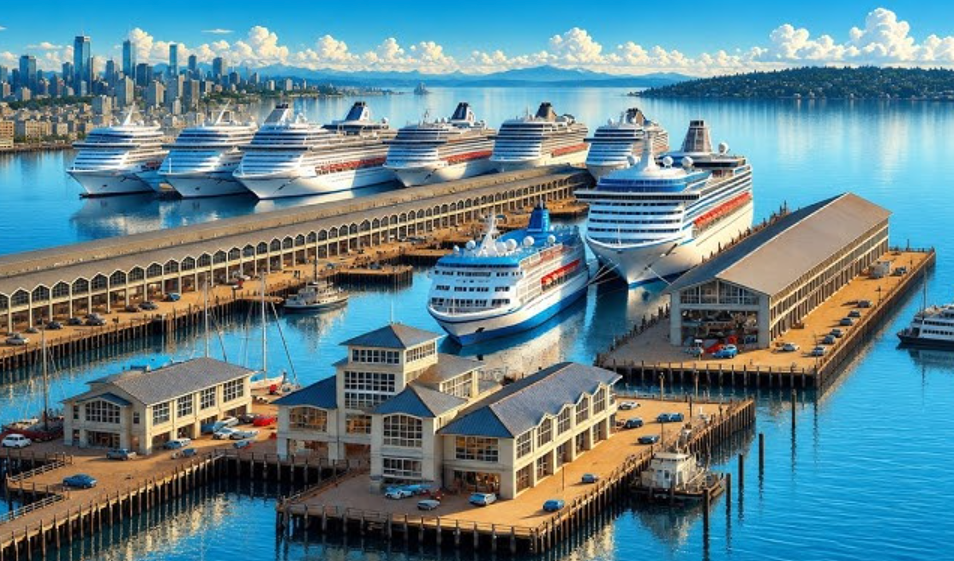
Seattle has two primary cruise terminals, and they are not in the same place.
Bell Street Pier Cruise Terminal at Pier 66 is on the downtown waterfront. Smith Cove Cruise Terminal at Pier 91 is farther north.
This matters.
Simply telling a driver, hotel employee, or travel companion that you are going to “the cruise terminal” is not enough. Check your cruise documents and confirm the pier before departure.
Pier 66
Pier 66 is closely connected with the downtown waterfront.
For travelers staying nearby before a cruise, this location makes it possible to combine embarkation day with a short Seattle visit. Pike Place Market and much of the central waterfront are nearby, making this area particularly appealing to passengers who arrive a day early.
Pier 91
Pier 91 is north of the central downtown waterfront and generally requires a separate ride.
It is not the type of destination where most visitors will want to arrive after wandering through Downtown Seattle with their luggage.
If your ship departs from Pier 91, planning the final transfer in advance can remove an unnecessary complication from embarkation morning.
Should You Fly Into Seattle on the Same Day as Your Cruise?
Whenever possible, arriving at least one day before departure is the more comfortable strategy.
Flights can be delayed. Checked bags can take longer than expected. Traffic can change. Even a minor disruption becomes stressful when a ship has a fixed departure schedule.
Arriving the previous day turns the beginning of the cruise into part of the vacation instead of a race against the clock.
It also gives you an opportunity to experience Seattle.
Depending on your arrival time, even a short stay can include Pike Place Market, the waterfront, Seattle Center, or dinner overlooking Elliott Bay.
Then, the following morning, you only need to travel from your hotel to the correct terminal.
Seattle Is a City Where Luggage Changes Everything
Many transportation comparisons focus on price and travel time while ignoring luggage.
That is a mistake, especially for cruise passengers.
Two adults taking a weekend trip with carry-ons can comfortably use transportation that becomes inconvenient for four people carrying several large suitcases.
Think about the entire journey:
- Airport terminal → transportation → hotel entrance → hotel room → transportation → cruise terminal.
Every additional transfer means lifting, moving, and keeping track of bags.
This is one reason direct transportation becomes more attractive as group size and luggage count increase.
The cheapest option on paper is not always the easiest option in practice.
Staying Downtown Before Your Cruise
For first-time visitors, Downtown Seattle can be an excellent pre-cruise base.
You can explore several major attractions without spending much of your limited time traveling across the region.
Pike Place Market is an obvious starting point, but do not treat it as nothing more than a quick photo stop. Wander through the market, follow the streets toward the waterfront, and leave enough time to enjoy the surrounding neighborhood.
If your schedule allows, Seattle Center provides another concentration of attractions and gives visitors a different perspective on the city.
One advantage of staying centrally is that you can experience quite a bit of Seattle during a short stopover without renting a car.
Do You Need a Rental Car in Seattle?
For a short stay centered around Downtown Seattle, often not.
Parking adds another consideration, and many central attractions can be reached on foot or with public transportation.
A rental car starts making more sense when Seattle is only the beginning of a wider trip.
Perhaps you are spending several days exploring Washington after your cruise. Maybe you are heading toward the mountains, taking a road trip through the Pacific Northwest, or visiting destinations that are difficult to reach without a vehicle.
But renting a car just to travel from SeaTac to a downtown hotel, park overnight, and then drive to a cruise terminal the following morning can create more logistics than it solves.
What if Your Destination Is Bellevue or the Eastside?
Not every visitor arriving at SeaTac is heading to Downtown Seattle.
Bellevue and the Eastside have become major destinations in their own right, particularly for business travelers.
If your hotel, meeting, or event is in Bellevue, Redmond, Kirkland, or another Eastside community, do not base your transportation decision on a typical “SeaTac to Downtown” guide. Your route and travel time will be different.
The same is true for people traveling farther north or south.
This is where checking the actual destination before booking airport transportation becomes especially important.
Combining Seattle With Woodinville
Travelers with an extra day sometimes look beyond the city itself.
Woodinville is a popular example.
It offers a very different experience from Downtown Seattle and can fit nicely into a longer Pacific Northwest itinerary. For visitors interested in wineries, restaurants, and a slower day away from the center of the city, it can be an appealing addition.
However, this is also the point at which transportation planning becomes more important. A day that involves several stops outside Seattle is fundamentally different from walking between downtown attractions.
Plan the transportation as part of the experience rather than trying to solve each ride individually once you are already there.
Early Flights Require a Different Strategy
A transportation option that feels perfect at 2 p.m. may not be the option you want for a very early morning departure.
If your return flight leaves early, work backward from the time you need to be at the airport.
Consider:
- your hotel’s location;
- airline check-in requirements;
- whether you are checking bags;
- the size of your group;
- and the possibility of road delays.
Do not plan based purely on the fastest drive time you see on a map.
Airport travel is much more relaxed when there is a reasonable buffer built into the schedule.
Families Should Plan Around the Most Difficult Part of the Trip
Traveling with children changes transportation priorities.
Instead of asking only, “What is fastest?” think about which option requires the fewest complicated transitions.
After a flight, moving children, bags, and personal belongings between trains, sidewalks, and another vehicle may not be worth a modest saving.
The same applies to multigenerational trips where some travelers may find long walks or repeated luggage handling difficult.
Convenience has a different value when you are responsible for more than your own suitcase.
Groups Should Think in Terms of the Whole Party
For several people traveling together, comparing transportation one passenger at a time can be misleading.
The better question is whether the entire party can travel together comfortably with all its luggage.
Splitting into multiple vehicles creates another set of problems: different arrival times, different pickup points, and the possibility that one part of the group reaches the hotel or cruise terminal before everyone else.
For group travel, coordination can be just as important as the vehicle itself.
A Few Hours Between Your Cruise and Your Flight?
This is another situation where travelers often overlook Seattle itself.
If your cruise ends in the morning but your flight does not leave until late afternoon or evening, heading directly to the airport may mean spending most of the day inside a terminal.
Depending on luggage arrangements and flight timing, you may be able to use those hours to enjoy one final meal, visit the waterfront, or explore an attraction you missed before the cruise.
The key is planning around the bags.
Solve the luggage problem first, and the rest of the day becomes much easier.
Build Transportation Into the Trip Before You Arrive
Seattle gives visitors plenty of transportation choices. The trick is using each one where it works best.
Light rail can be excellent for a lightly packed traveler heading downtown. Walking makes sense once you are exploring compact parts of the city. Rideshare and taxis provide flexible point-to-point transportation. Private transportation can be useful when luggage, groups, cruise schedules, or airport timing make predictability more valuable.
There is no single answer that works for every Seattle visitor.
The best approach is to look at the complete itinerary before the trip begins.
Where are you going after SeaTac? How many people are traveling? How much luggage do you have? Which cruise terminal do you actually need? Are you spending time in Seattle or simply passing through?
Answer those questions before landing, and Seattle becomes a remarkably easy city in which to begin — or end — a Pacific Northwest journey.